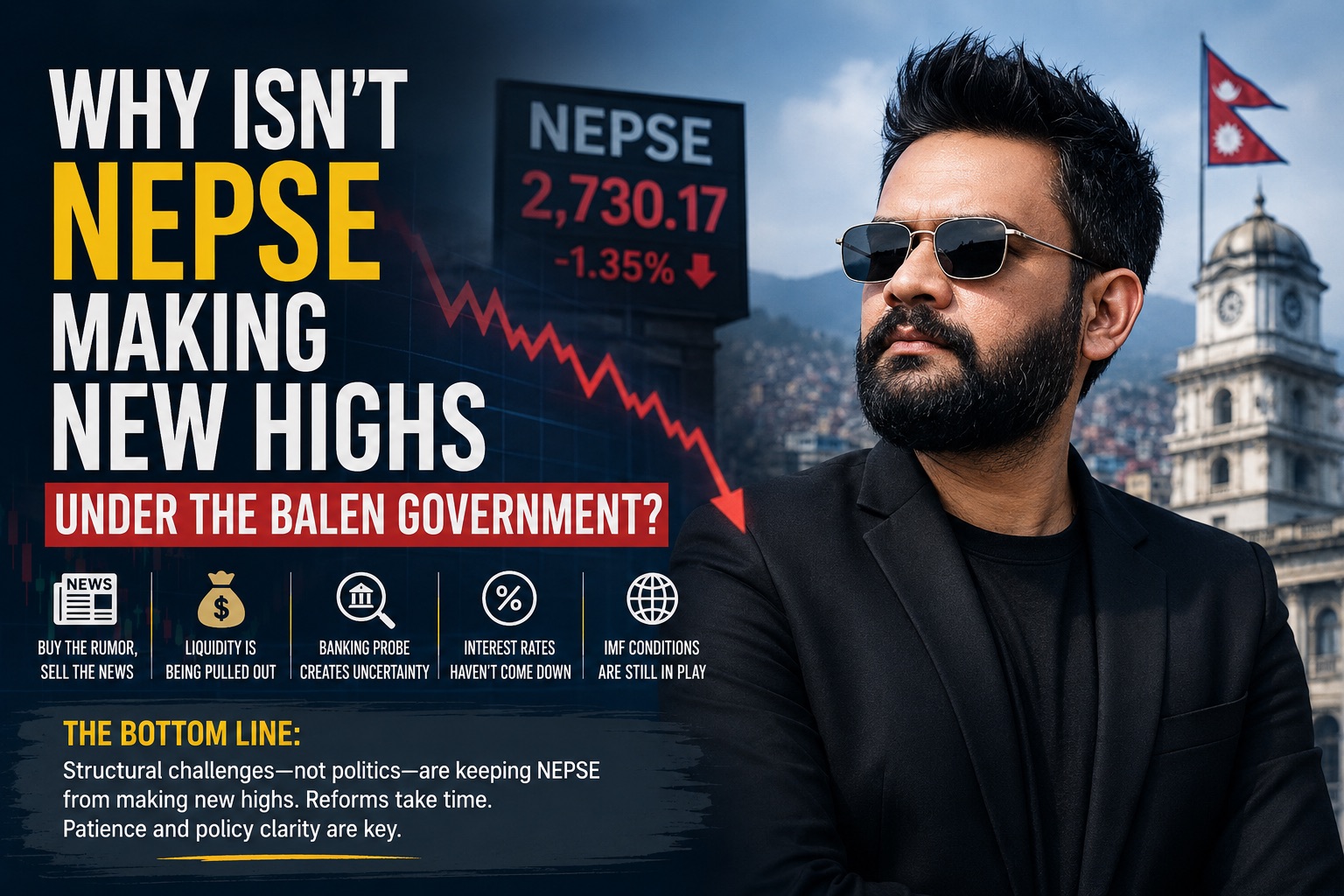
Why Is NEPSE Falling Despite a New Government?
By Market.Nerds
When a new government takes office, investors typically expect stronger economic policies, greater political stability, and reforms that support business growth. These expectations often create optimism in the stock market.
However, Nepal's stock market (NEPSE) has continued to trend lower despite the formation of the new government. This has left many investors asking a simple question:
Why is the market falling when expectations were so high?
The answer is more complex than simply pointing to one government or one policy. Stock markets move based on expectations, confidence, liquidity, and the broader economic outlook.
1. Expectations Were Extremely High
Following the formation of the new government, investors expected:
Faster economic reforms
Clear capital market policies
Greater political stability
Stronger support for private-sector growth
Initially, these expectations created optimism. However, as investors waited for concrete policy actions, confidence gradually weakened. Analysts note that expectations for stability and market-friendly reforms have not yet translated into stronger investor confidence.
2. Investor Confidence Matters More Than Promises
Financial markets react not only to announcements but also to confidence.
Although Nepal currently has relatively comfortable banking liquidity and lower interest rates, many investors remain cautious because they are still waiting for consistent policy implementation and clearer long-term direction. This lack of confidence has contributed to reduced buying interest.
3. Lower Trading Activity
One noticeable trend during the recent decline has been weaker trading volume.
When investors become uncertain:
Fewer new investors enter the market.
Existing investors delay large purchases.
Daily turnover declines.
Lower participation reduces buying pressure, making it harder for the market to recover. Recent reporting indicates both turnover and active participation have softened alongside the market decline.
4. Policy Uncertainty
Investors value predictability.
Even when reforms are proposed, uncertainty about taxation, regulatory changes, and implementation timelines can lead investors to adopt a "wait and see" approach.
Markets generally reward consistency more than short-term announcements.
5. Market Psychology
Markets are driven by both fundamentals and emotions.
When prices continue falling:
Fear increases.
Profit-taking accelerates.
Retail investors become hesitant.
Negative sentiment spreads quickly.
This creates a cycle where weak confidence leads to more selling, which further weakens confidence.
6. The Broader Economy Also Matters
The stock market does not operate in isolation.
Economic growth, corporate earnings, employment, consumer spending, inflation, and credit growth all influence investor expectations.
Even if political leadership changes, improvements in these indicators usually take time before they are reflected in company profits and share prices.
Why This Matters for the Government
A healthy stock market benefits more than investors.
A stronger capital market can:
Improve business access to capital.
Increase investor participation.
Generate higher capital gains tax revenue.
Support entrepreneurship and economic growth.
Recent reports indicate that lower market activity has also reduced government capital gains tax collections compared with the previous fiscal year, highlighting the broader economic impact of prolonged market weakness.
What Should Investors Do?
Periods of market weakness can be uncomfortable, but they are also part of investing.
Rather than reacting emotionally, investors should focus on:
Company fundamentals
Risk management
Diversification
Long-term investment goals
Patience during periods of uncertainty
Trying to predict every short-term market movement is often less effective than maintaining a disciplined investment strategy.
Final Thoughts
The current decline in NEPSE cannot be explained by a single factor or by the government alone. It reflects a combination of elevated expectations, weaker investor confidence, policy uncertainty, softer trading activity, and broader economic conditions.
For the market to regain momentum, investors will likely look for consistent economic policies, regulatory clarity, stronger corporate performance, and evidence that confidence is returning.
In investing, confidence is built over time through credible actions and predictable policy—not overnight.
Market.Nerds believes that informed investing begins with objective analysis rather than emotion. Understanding why markets move is the first step toward making better investment decisions.